
Strategies To Tame The Lady Knight
Introduction
The image of the lady knight is an enduring and recurring romantic motif often found in fantasy literature. From The Cave of the Golden Rose (1991) to Game of Thrones (George RR Martin 1996-present; HBO 2011-2019), the lady knight has seized our imagination as a heroine, a female warrior filled with fighting prowess. Respected and feared by their peers, they stride confidently. They are often beautiful, gorgeous to behold, and they instill a sense of admiration because they are powerful knights, surpassing even their masculine counterparts.
However, the lady knight of the late medieval and Renaissance epics was the subject of contention. Her body became the battlefield where mostly male writers and poets debated her validity as a warrior. And even more when these writers were confronted with a real-life lady knight in the form of Joan of Arc, the anxiety to portray the lady knight as powerful but still within the confines of patriarchy led to various tactics and strategies, where they rendered her harmless. In some ways, they relied on the existing foundation of Greek and pseudo-Greek stories about the Amazons. In others, they drew on Biblical sources and hagiographies.[1] And yet, like a seam of mica in layers of granite, a theme emerged: the female warrior soon bore long hair, fair skin and well-proportioned features. The lady knight became feminised, sexualised and an object of masculine fantasy.
In this essay, I will discuss various strategies by which the literary lady knight—and to some extent, the historical Joan of Arc—was rendered harmless by being turned into a romantic figure ready to be rescued by the male hero or to be protected by a band of men. These strategies ultimately froze vibrant and real characters into friezes and statues. They were forced into icons: nice to look at and nothing else.
The idea of the lady knight asserted a powerful impression upon the imagination of the audience of the late medieval and Renaissance period between 1300 and 1600. Bradamante, Britomart, Marfisa and Clorinda were all skilled warriors who often bested their (masculine) opponents.[2] By all means, they had the potential to become literary role models; the motif of the female warrior was a symbol of protofeminism or pro-woman literature. Yet, the lady knight was also a paradox, a figure imbued with tensions. She transgressed social and political norms. She donned masculine garb. She knew how to use weapons (sword and lance). She was dangerous. So the writers, poets and artists took pains to mitigate and reduce the danger. Even in the “praise and defense of woman” genre, there was still the subtle assertion of patriarchy.
Exceptional circumstances and the female champion
The literary epics and treatises of the late medieval and Renaissance period often involve women who transcend their normal boundaries of domesticity and the private sphere in times of crisis. The exceptional status of these women can be seen in their sense of, and enjoyment of, freedom and autonomy. They are educated, mobile and active in masculine realms of war and government. The modicum of freedom enjoyed by these exceptional women was unattainable by the rest of womanhood. Their positive qualities of chivalry, strength and prowess as knights were admirable, even exalted. However, they were still deemed exceptional.
Exceptions could be made in times of crises, and were therefore excusable. ‘Exceptional circumstances’ were used to explain the transformation of the women.
And the women themselves were characterised as exceptional, too. They became champions, fighting for a noble/holy cause.
The distinction between these two categories is slight but analytically useful. Firstly, the ‘exceptional circumstances’ category allays the anxieties of writers (and their audiences) by placing these women in special, exceptional events that would not generally happen; such events were by definition deemed very rare. The women in these special occurrences were therefore considered exceptional as well.
Secondly, the lady knights themselves were exceptional. The lady knights were already born privileged: they were members of the aristocracy and already had access to wealth. And then, they took up arms, a masculine sport. They are also categorised as exceptionally strong— endowed with strength beyond the common run of their sex. The strategic move is to class these women as exceptional, almost supernatural—and therefore impossible for ordinary women to imitate. The position occupied by these women borders on 'unique' and is an indication of almost-mythical rarity like an unicorn or any fabled creature. Marfisa, the Saracen warrior from Orlando Furioso, has been described as a ‘phoenix’. To the writer Ariosto, she seems as rare as the mythical bird.[3] Since the taking of arms was unlikely to occur in ‘real life’, writers and their audiences would then breathe a sigh of relief.
We also see another two overlapping strategies at work in the epics: the strategy of the exceptional woman (in which the lady knight is praised for her exemplary behavior and capabilities), and the strategy of the female champion (where the lady knight is given a cause to fight, ostensibly for mankind though at times, specifically for men).
These categories and strategies could be said to exist for Joan of Arc.
The real-life (exceptional) crisis that enabled Joan was France's predicament in the Hundred Years' War (1337-1453). Christine de Pisan and Jean Gerson (1429)[4] depicted a Joan who was aided by a God whose Spirit had miraculously entered into her, thus altering and modifying her identity. Joan was described by de Pisan as a "maidenly Mars".[5] Similarly, she was described as "a proud prince" by Martin Le France.[6] Joan transcended her traditionally feminine boundaries, took on a male persona and embodied a male spirit, thus enabling her to assume the role of a warrior. Joan was, then, an exceptional woman: she was born exceptional; she was also infused by the spirit of God. God's masculine Spirit legitimised Joan's radical change and sanctioned it, therefore granting Joan the aura of a holy warrior, a crusader knight. Both de Pisan and Gerson contributed to the strategy by adhering to the common discourse of a woman transcending/overcoming normal boundaries in times of crisis, danger or emergency, by way of a miraculous infusion. In this fashion, she became a female champion. Viewed from this angle, Joan became no more than a literary lady knight, miraculously called to battle for her family (or nation).
This presentation of the exceptionality of Joan of Arc and her literary sisters indicates that despite the praise, defense of their existence and strategies used, even though the lady knights are described and portrayed as men, they are still considered women and the value systems attached to the categories 'male' and 'female' still remain in place. The impossible lengths and incongruous strategies taken by writers show how anxious they are to 'disprove' (and disapprove of) the independence and freedom enjoyed by the lady knights. Their perceived independence is just a miracle, an infusion of a deity’s spirit in a mortal vessel.
Revelation of true gender
To reinforce the idea that the lady knights were ultimately still women, the writers and even artists resorted to revealing of the lady knight’s true gender, often in dramatic (and sometimes, graphic) fashion. The 'hair revelation' scene was a device often used by writers to reassure their readers (especially the men in the audience) that the lady knight was really a woman.
Clorinda from Jerusalem Delivered was revealed in this fashion. Tancred's lance removed Clorinda's helmet with the overtly sexual (and intrusive) use of the Italian word 'nuda' (literally, 'nude'):
Meanwhile Clorinda moves to meet Tancred’s assault, and puts her lance in rest. They struck one another on the visor and the shafts flew high, and she remains partly denuded by it: for her helmet, its laces broken, he struck bouncing from her head (a marvellous blow!), and in the midst of the field a youth maiden, her golden locks all scattered to the winds.[7]
The word “denuded” (Italian "nuda") sounds as if the writer is deliberating disrobing the lady knight, revealing her real gender. It has also connotations of humiliation and embarrassment. The writer is literally 'disrobing' the female knight.
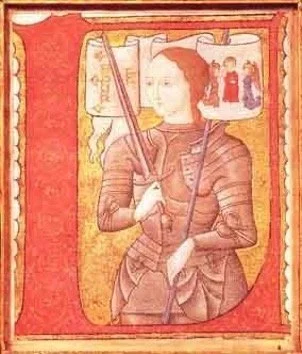
Figure 1[8]
A similar strategy was applied to Joan of Arc. In Figure 1, Joan is given red or golden-red hair. The hair is tied in a modest braid. Even in her armour, it is very clear that Joan is female. The long hair (or even the hint of it) reveals that the warrior is actually a woman.
This particular literary and artistic device allowed the writers and artists to expose the true sex of the lady knights, so that the fears associated with the female warrior were easily diminished by the sight of her long feminine hair. The golden tresses of Bradamante, Britomart and Clorinda reassured the reader of their inherent womanhood. Their armour might hide the rest of their bodies, shield them from recognition and identification. But the sight of the long hair removed that sense of 'disguise' at one stroke. Likewise, Joan's 'real' gender was revealed by art: the long golden or russet hair re-introduced by artists brought back her biological femininity. Like her literary sisters, Joan's armour had no defense against this device which stripped her of her independence.
Feminisation
With the revelation of their true gender, it is easy to see the next strategy: the lady knight was feminised. She was given long hair, feminine features and external clothings like gowns. In a radical physical/bodily re-construction, the lady knight was covered in a modest woman's dress. Bradamante dons a dress at the end of the Orlando Furioso (1516-1532). Similarly, you see the same tactic used on a real lady knight. Joan, like her literary knightly kin, was reverted back to womanhood in spite of the known fact of her short hair (which was later shaved during her trial). Artists gave her back her long hair, turning her into a woman, not a warrior. She was often clad in a gown or dress (Figure 2). A skirt-like garment (gown?) covers the lower half of her body, shielding her legs, making her appear more lady-like and less aggressive than a warrior. An interesting point to note was that the coiled hair implied long hair.
The visual impact of Joan's long hair quickly and effectively neutralised the inherent threat of the woman warrior, reassuring the reader or spectator that the knight in the picture did not pose any real danger because of her obvious/overt femininity. Feminisation was not just hair but also external things like clothing. As indicated in the Vigiles (late 1400s), Joan's warrior identity was quickly modified to a more traditional one: the harmless maiden in a gown. Her gaze was downcast, an indication of her womanish modesty, and she was being surrounded by a group of men. (Figure 3) Her 'masculinity', as typified by the wearing of full-body armour, was quickly and artistically erased by the substitution of the feminine gown and the drawing of long golden hair.
In the end, the lady knights were relegated to getting married and becoming wives in the end (and, the authors of the epics hoped—mothers to scions of dynasties) and damsels in distress, watching the action from the sidelines. Joan was still relegated to woman. Even by focusing only on their positive qualities, the acknowledgement of their full identity was denied.
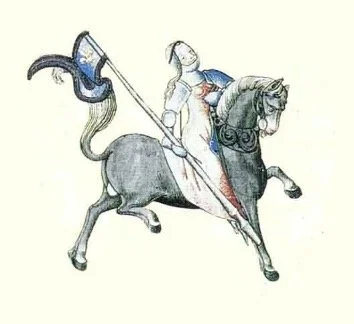
Figure 2 [9]
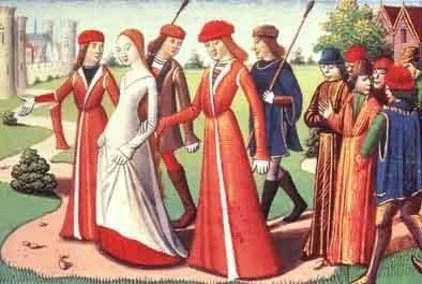
Figure 3 [10]
Conclusion
The strategies used by the writers acted as mouthpieces for the patriarchy when those writers seemed to promote and praise womanhood in the depictions of the lady knights. The female warriors stood outside of womanhood, so much so that they were incomparable to the extent of extreme rarity. No other woman could easily imitate them. They possessed the luxury of autonomy, entering into the masculine realm of war and chivalry. The writers waxed lyrical on their capabilities (some of the lady knights were war leaders in charge of armies). Yet, on the other hand, the strategies became self-defense mechanisms, weapons used by writers to protect themselves. They did not want to be seen as overtly supportive of female autonomy and independence.
The strategies used to describe Joan shared commonalities with the portrayals of the lady knights: there were (literary and artistic) convergent lines that met.
The writers and artists made use of a common discourse, portraying Joan as lady knight and champion. She became the long-haired (usually blonde) aristocratic maiden, resplendent in either silver armour or a feminine gown. Her features became slender, her peasant features smoothed/glossed over, and she is feminised with fair skin (an implicit hint of privileged lives spent mostly indoors – which was totally incompatible with the rough-and-tumble and active lives of warriors or farmers). In short, Joan became a romantic heroine, like the Renaissance lady knights. As time progressed, the image of Joan gradually evolved, becoming more and more like a literary lady knight, astride a charger and starring as the main protagonist in a romance. Like the lady knights, she quickly attained many devoted love interests and admirers. Joan became an object of love, a sexual being. In fact, she was so magnificent she even surpassed Bradamante. [11]
Joyce Chng lives in Singapore. Their fiction has appeared in The Apex Book of World SF II, We See A Different Frontier, Cranky Ladies of History, and Accessing The Future. Joyce also co-edited THE SEA IS OURS: Tales of Steampunk Southeast Asia with Jaymee Goh. Alter-ego J. Damask writes about werewolves in Singapore. Their YA fantasy, Fire Heart, is published by Scholastic Asia. You can find them at http://awolfstale.wordpress.com and @jolantru on Twitter. (Pronouns: she/her, they/their.)
Notes
[1] Marina Warner has written eloquently about this in Joan of Arc: the image of female heroism.
[2] Bradamante: Orlando Innamorato (late 1400s) by Matteo Maria Boiardo and Orlando Furioso (early 1500s) by Ludovico Ariosto.
Britomart: The Faerie Queene (1590-1596) by Edmund Spenser.
Marfisa: Orlando Furioso (early 1500s) by Ludovico Ariosto.
Clorinda: Jerusalem Delivered (1581) by Torquato Tasso.
[3] Ariosto, Orlando Furioso , canto 36, stanzas 14-23, p. 433. Lillian Robinson also discusses Marfisa’s unique nature: “The phoenix …symbolizes both her unique achievement and her solitary sexual condition.” Monstrous Regiment, p. 181. Clorinda’s symbol is the tigress, another creature known for its solitary nature.
[4] Christine de Pisan, Le Ditie de Jehanne d'Arc (1429); Jean Gerson, De quadam puella (1429).
[5] Fraioli, Deborah, “The Literary Image of Joan of Arc: Prior Influences”, Speculum, University of Chicago Press, 1981.
[6] Martin Le France, Champion des dames, p. 188.
[7] Tasso, Jerusalem Delivered, canto 3, stanza 21, p. 55. See also the Italian version, La Gerusalemme Liberata, Milano, Liberia di Educazione E D'Istruzione, di Paolo Carrara, editore, 1965: "Clorinda intanto ad incontrar I'assalto/Va di Tancredi, e pon la lancia in resta./Ferîrsi alle visiere, e I tronchi in alto/Volaro; e parte nude ella ne resta…" (p. 118).
[8] Joan of Arc, Franco-Flemish school, 15th century, Archives Nationales, Paris
[9] Joan of Arc, Le Champion des Dames, Bibliothèque Municipale, Grenoble.
[10] Joan, accompanied by her escorts, Vigiles des Charles VII, Bibliothèque Nationale, Paris
[11] Joan was so great that she surpassed even Bradamante who later became the protagonist of an 18th century opera by Louis Lacoste. The term “surpassing Bradamante” was a reference made by the author’s thesis supervisor, the late Philippa Maddern. Likewise, the term is also the title of the Master of Arts dissertation by this author.